Life in the UK test history questions: what to expect
A guide to the history topics and question styles on the Life in the UK test, with tips for remembering key dates and events.
By James Holloway · ESOL Educator & Test Prep Specialist
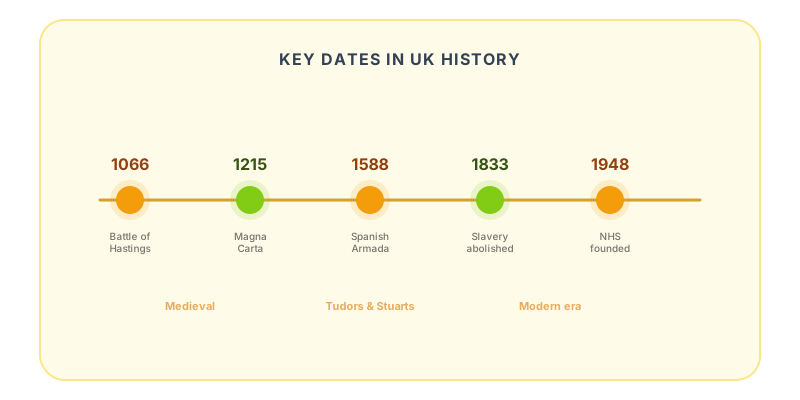
History is the section that trips up the most people on the Life in the UK test. It spans thousands of years, from early Britain to the 20th century, and includes dates, events, and figures that many candidates have never encountered before.
How much of the test is history?
The history chapter — A long and illustrious history — is the longest section in the official handbook. While the test draws questions from all five chapters, history questions often make up a significant portion because the source material is so large.
Key periods you need to know
The handbook breaks history into clear eras. Here are the areas most likely to come up:
Early Britain
- The Romans, Anglo-Saxons, and Vikings
- Key fact: the Romans left Britain in AD 410
The Middle Ages
- The Norman Conquest and the Battle of Hastings in 1066
- Magna Carta signed in 1215
- The Black Death in 1348
The Tudors and Stuarts
- Henry VIII and the break with Rome
- Elizabeth I and the defeat of the Spanish Armada in 1588
- The English Civil War and the execution of Charles I in 1649
- The Glorious Revolution of 1688
The 18th and 19th centuries
- The Act of Union with Scotland in 1707
- The Industrial Revolution
- The abolition of the slave trade in 1807 and slavery in 1833
- The growth of the British Empire
The 20th century
- World War I (1914–1918) and World War II (1939–1945)
- The creation of the NHS in 1948
- Decolonisation and the Commonwealth
- The UK joining the European Economic Community in 1973
"History is where most marks are lost, but it is also where the biggest gains come from targeted revision. If you can build a timeline in your head for each era, the specific questions become much easier."
— James Holloway, ESOL Educator & Test Prep Specialist
Types of history questions
You will not be asked to write essays. All questions are multiple-choice. Common formats include:
- Date matching — "In which year did [event] happen?"
- Who did what — "Who was the first [role/title]?"
- Cause and effect — "What was the result of [event]?"
- True or false style — "Which of the following statements is correct?"
Tips for remembering history facts
Group events by era
Rather than memorising isolated dates, build a mental timeline for each period. Understanding the sequence helps you reason through questions even if you forget a specific year.
Use flashcards for key dates
Some dates come up repeatedly. Make a short list of the most important ones (1066, 1215, 1588, 1707, 1833, 1918, 1945, 1948) and review them daily.
Connect facts to each other
Linking facts makes them stickier. For example: Henry VIII broke with Rome → this led to the Church of England → Elizabeth I later defended Protestant England against the Spanish Armada.
Test yourself, do not just read
Reading the handbook once is not enough. Use smart review to actively recall facts and identify gaps in your knowledge.
Do not ignore the other chapters
History is important, but do not let it crowd out the rest of your preparation. Questions on values, government, culture, and modern society also appear on every test. Follow a balanced 4-week study plan that gives each chapter the attention it needs, and watch out for the 7 common mistakes that trip people up.
Practise with real-format questions
The best way to prepare for history questions is to see them in context. Take a timed mock test to experience how history questions mix with other topics under exam conditions.
Start studying history topics for free with PassLifeInUK.
Disclaimer: This content is for general information only and does not constitute immigration advice. For advice about your individual circumstances, consult a qualified immigration adviser registered with the OISC or a regulated solicitor. Information may change — always check GOV.UK for the latest official guidance. See our editorial policy and corrections policy.